Tuesday, December 30, 2008

China's Stock Market Investor's

The Shanghai stock exchange experienced tremendous growth in 2006 and 2007. During those years there were more IPOs in Shanghai than in New York.

The Shanghai exchange IPOs were primarily state owned enterprises. The Central government encouraged these IPOs in order to encourage these state owned enterprises to raise capital that could be used to reduce the government subsidies for those enterprises. This subsidy reduction for the central government released capital for other uses.

At the same time individual and institutional investors were encouraged to buy stocks through brokers. The market heated up and the market rose to more than 6,000 points at its highest. Investors felt the market could only go higher because they had never seen a market downturn. Brokers and analysts encouraged this wave of investing as well.

The majority of listed companies did not have transparent financials. There was not a system of objective stock analysts judging these companies so individual investors continued to buy.

Many investors sold their homes and other assets to invest in the market. many believe the bias toward gambling among many investors fed this wave of investing as well.

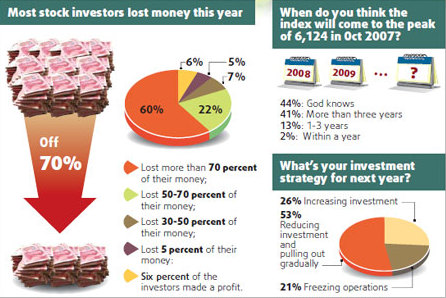
In late 2007 and early 2008 the market began to drop rapidly due to poor earnings and a general slow down in the economy. Individual investors began to loose huge amounts of capital. They did not have balanced portfolios but instead were fully invested in the stock market.

The net result is that the objectives of reducing subsidies was achieved on the back of indidual investors. The China Daily survey below demonstrates the impact of these losses.

The lesson from this calamity is that bubbles burst and when they burst everyone gets wet !


Toasting - Joining The Group

Anyone who has entertained or been entertained in China has come across the toasting ritual.

Toasting in China is a way to create and receive "face" from friends and colleagues. By toasting your friend or colleague you are asking them to partake "first" which allows you to then drink your beverage of choice. Rarely do people sitting around a banquet table drink beer or wine "by themselves." It is more appropriate to drink in pairs or in groups than by yourself. Solo drinking is viewed as selfish and impolite.

At a banquet table the host always sits in the seat facing the door. The most important guests sit to his/her left and right. The host must wait for the banquet's choice of beverage to be poured for all guests before he/she raises their glass in a "group" toast which signifies the meal has begun.

Once the meal is underway the other guests will toast the host to show their appreciation. This is a direct toast with the host. Each person at the table should toast the host beginning with the most senior guest and continuing until everyone has completed toasting the host.

Then everyone is free to toast the host's friends and colleagues. Usually the guests do not toast each other unless they are meeting for the first time. If they do toast each other it is done at the end of the meal or done discretely.

Usually the waiter or waitress keeps the glasses full during the meal - usually small glasses. This is important in order to always have the opportunity to toast someone in case you yourself want to take a drink !

It is important never to be "cheap" with liquor at an important dinner in order to make sure everyone is enjoying themselves. One does not have to drink excessively but one needs to participate in the process.

Depending on who the host is determines how much one must drink each time. If the host is a good drinker then both parties usually drain their glasses on each toast. Women are usually exempted from this requirement if they declare up front that they are not "real drinkers."

The meal is usually closed by the host raising his/her glass to everyone as a group and draining the remaining wine or liquor so as not to leave anything to waste.

Regardless of one's ability to drink it is important to participate in this ritual so as to be brought into the "group" and make friends.

Good luck !

Thursday, December 25, 2008

Merry Christmas From Shanghai

Merry Christmas everyone !

Christmas Day in Shanghai is cold and overcast this year. No snow but lots of cold weather.

The city does not stop for this holiday although it has become a day that most Chinese acknowledge as a holiday (without the religious celebration).

Local Chinese celebrate Christmas by going out for dinner with friends and then going to sing songs together with friends. It is more of a reason to have fun than a holiday that has western Christmas connotations.

We're all hoping for a better New year in 2009 than we had in 2008 !

Merry Christmas and Happy New year to everyone !

Sunday, December 21, 2008

Inside - Outside: 外面跟内面

Traditional Chinese courtyard architecture is characterized by a courtyard layout. The outer walls of the courtyard encircle inner courtyards with separate smaller courtyards for different members of a family's generation tree.

The outside walls when seen from the street or alleyway look inconspicuous and many times downright rundown. it is unclear what lies behind the walls - inside the courtyards.

The main gate of the courtyard is also a barrier to outsiders and bad spirits. Immediately in front of the main gate on the inside is a wall which blocks the visitor's view of the inner courtyards. Entrance is gained by the side paths around the "gateway wall."

As with Chinese traditional architecture, Chinese culture is equally "walled" off from outsiders. Starting with the Great Wall of China and the traditional feudal city walls of pre-modern China, outsiders have found it nearly impossible to find their way to the center courtyard of Chinese culture.

We randomly wander the outside walls of the courtyard in search of an entrance way into Chinese culture. Most fail. The failure is caused by "Potemkin-style" images of Chinese culture. These are illusions based on historical complexity which remain intentionally difficult to decipher.

Doors are opened that lead to dead ends. Threads are pulled which lead to barren rooms without any explanation.

The first key available to most visitors to Chinese culture is the Chinese language. This key is available globally. It has been duplicated many times by both Chinese and foreigners alike. The key fits the culture lock and is often able to open a few doors. The challenge is that the copies of this key are not precise. Sometimes it works and many times it fails.

This failure is rooted in the tonal nature of the Chinese language. using the wrong tone can cause you to swear at your mother rather than calling her "Mom." Failure can mean selling your watch rather than buying a new one.

For those who are able to turn the culture key repeatedly in the correct manner forging the first wall of the courtyard is possible and has been accomplished by many people across many years. Entering the first courtyard is the essential fist step.

Once inside the first courtyard one is calmed by a sense of understanding and appreciation. While one sense victory and accomplishment, the next door is more difficult to locate. It is narrow and hard to find. It melts into the courtyard wall. its keyhole is not obvious.. In fact a traditional key will not open this door.

The door can not be opened by one person alone. The traveler must join a group by forming relationships in order to understand how the door can be opened. Forming relationships is a tireless challenge laced with false starts.

I once invited a friend to lunch. I was building a relationship in search of the key. A noodle shop came upon me and I invited my friend to have luch together. The noodles were spiced with hot Sichuan chili peppers and was delicious. The meal was delicious. I paid the bill and left pleased with myself.

Later I heard from a mutual friend that my lunch companion was insulted by the fact that I had only invited him to eat noodles - a very basic meal. The meal was not high end enough. I had not given my new friend enough "face." I had not offered an expensive or unique meal but only a basic meal.

My attempt at joining this group had failed miserably and the hoped for new relationship had crashed and burned. I was never able to recover from that day ! I continued my search for the next door....

Through trial and error one can eventually find the second door and solve the puzzle that produces the key to a deeper understanding of Chinese culture. It takes years to find the next door and open it. When opened the sense of accomplishment is tremendous. It is not necessarily embodied in one event - one transaction but is more of a process. Success comes upon you after you have crossed the threshold of the sought after door !

This process of entering the next inner courtyard continues forever. Locating and entering the inner most courtyard is a lifelong task that may not be completely achievable. Life is a journey. Understanding Chinese culture adds an exciting and challenging component to this journey.

When one views a tired and rundown wall don't be fooled that this is a sign of poverty or disrepair. The wall is the "outside" and does not represent what is "Inside."


President Obama's China Visit

With 30 days to go until the new president of the United States is sworn into office I have been debating with friends and colleagues which country President Obama will visit first after he is inaugurated and Senator Clinton is confirmed by the Senate.

The short list of countries currently includes:

1. United Kingdom - the traditional favorite

2. Canada - Essential to Detroit rescue plan

3. Japan - closest Asian ally

4. Mexico - a wild card nominee

5. China - Largest holder of US Treasuries

My logic for picking China as the first destination is based on the principle that you always visit your largest investor first - that means China.

If President Obama is serious about improving America's position in the world after 8 dark years under Bush then a visit to China would break new ground. it could prove to the entire world that Obama is serious about new directions --- he calls that change.

He can change the global game by demonstrating that a US-China global partnership could be friendly
and does not have to be confrontational. The US economy needs China's economy to keep expanding. China needs US technology and management know how. There is a natural match.

China built an industrial economy in 30 years. it took 100 years to accomplish the same level in the west. China also created 100 years of industrial pollution in 30 years. This is a GLOBAL GREEN opportunity for both nations.

Regardless of where President Obama goes first I'm sure it will be successful. A visit to China first would break new ground and set his administration's diplomatic direction - a direction of change.